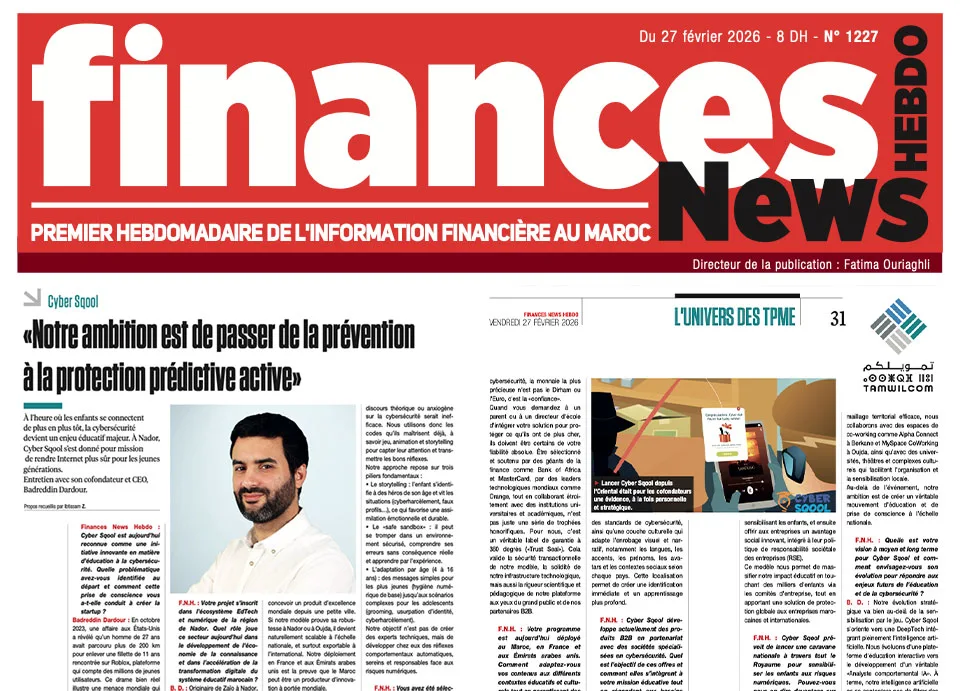
Cyber Sqool makes the cover of Finances News Hebdo N°1227. Co-founder and CEO Badreddin Dardour reveals the vision of a startup born in Nador and deployed in 3 countries — and its ambition to move to AI-powered predictive protection.
Friday, 27 February 2026. Finances News Hebdo — Morocco's leading financial weekly — dedicated a full feature to Cyber Sqool in its flagship section L'Univers des TPME (The World of SMEs).
Not Every Day Does a Startup from Morocco's Eastern Region Make the Cover of a National Weekly
The headline of the interview with Badreddin Dardour, co-founder and CEO of Cyber Sqool, sets the tone: "Our ambition is to move from prevention to active predictive protection."
This is not a marketing slogan. It is a technological roadmap. And what it reveals about where Cyber Sqool is heading deserves a closer look.
Finances News Hebdo N°1227 — digital edition →
1. Why Cyber Sqool Was Born — And Why It Was Urgent
It all started in October 2023 in the United States. A 27-year-old man drove over 200 kilometres to abduct an 11-year-old girl he had met on Roblox. This real-world incident crystallised a realisation for Badreddin Dardour. After more than a decade protecting corporations from cyber threats, he noticed an alarming paradox: we secure the servers, but the most vulnerable population — our children — remains defenceless.
From this observation, Cyber Sqool was born: not as yet another technological response, but as genuine digital immunity instilled from the earliest age.
2. The Pedagogical Approach: Play as a Shield
What fundamentally sets Cyber Sqool apart from any other awareness initiative is its rejection of fear-based discourse. "Our children are Digital Natives," explains Badreddin Dardour. "Imposing a theoretical or anxiety-inducing discourse on them would be ineffective."
The Cyber Sqool method rests on three foundational pillars:
- Storytelling. The child identifies with heroes their own age and experiences concrete situations — cyberbullying, fake profiles, manipulation — within a safe narrative framework.
- The safe sandbox. The child can make mistakes, understand errors, and learn from experience — with no real consequences.
- Age-appropriate adaptation, from 4 to 16 years. Simple messages on basic digital hygiene for younger children, through to complex scenarios for teenagers.
Develop automatic, calm, and responsible behavioural reflexes when facing digital risks — not train technical experts.
3. Born in Nador, Built for the World
Launching an EdTech startup from Nador — rather than Casablanca, Rabat or Marrakech — was a deliberate choice. "Innovation is not reserved for major cities," states Badreddin Dardour. Originally from Zaïo, with his co-founder from Oujda, the two entrepreneurs have proven that a world-class product can emerge from a small city in Morocco's Oriental region.
Today, Cyber Sqool is deployed across three countries:
- 🇲🇦 Morocco — home market, with growing presence in schools and institutions
- 🇫🇷 France — first international deployment
- 🇦🇪 United Arab Emirates — proof the model travels well beyond the Maghreb
4. Institutional Validation: Bank of Africa, MasterCard, Orange
In EdTech and cybersecurity, the most valuable currency is not financial. It is trust.
Cyber Sqool was selected as a national excellence finalist by Bank of Africa and MasterCard. Supported by Bank of Africa, MasterCard and technology leaders like Orange, Cyber Sqool has built what Badreddin Dardour calls a 360-degree Trust Seal: a label that validates transactional security, technological robustness, and pedagogical rigour all at once.
5. The B2B Model: Child Protection as a Competitive Advantage
With the spread of remote work, the boundary between office and home has dissolved — and a new vulnerability has emerged: a family device connected to the same network as a professional computer becomes an entry point for cyberattacks.
In this context, Cyber Sqool develops B2B partnerships with cybersecurity firms. Partners secure the technical infrastructure; Cyber Sqool adds the pedagogical and human dimension for employees' families. This model reaches thousands of children through corporate employee benefit programmes — while reinforcing the overall security of Moroccan and international organisations.
6. The National Roadshow: Cyber Weekends
Beyond the digital, Cyber Sqool is preparing a physical deployment across the Kingdom: a national roadshow — the Cyber Weekends — that transforms major national and international child protection guidelines into an accessible educational tool for every family, in every city, neighbourhood, and school.
Because children's cybersecurity cannot remain an urban privilege.
7. The 2026 Vision: From Prevention to Predictive Protection
Cyber Sqool no longer positions itself solely as an interactive education platform. It is moving decisively toward DeepTech, with the development of an AI-powered behavioural analyst capable of operating on two axes:
- Real-time predictive detection. Identifying patterns of digital radicalisation, cyberbullying, or psychological distress signals — before the situation escalates.
- Adaptive learning. Personalised scenarios based on each child's specific vulnerabilities, for targeted, effective training.
The entire system is built on a strict Privacy by Design principle, guaranteeing children's data confidentiality and anonymity — in compliance with the most demanding international standards, including GDPR.
Position Cyber Sqool as a benchmark behavioural shield, built in Morocco, with international reach.
What This Publication Represents
Being featured in Finances News Hebdo — Morocco's leading financial weekly — is not a minor milestone. It is a strong editorial endorsement from a publication read by decision-makers, investors, and institutional leaders across the Kingdom.
For Cyber Sqool, this feature means one simple thing: the issue of children's cybersecurity is now taken seriously at the highest levels of Morocco's economic ecosystem.
And we are only just beginning.
✍️ A heartfelt thank-you to Ibtissam Zerrouk, journalist-reporter at Finances News Hebdo, for this in-depth interview and her ability to grasp the issues of children's cybersecurity with precision and sensitivity.